
In This Article
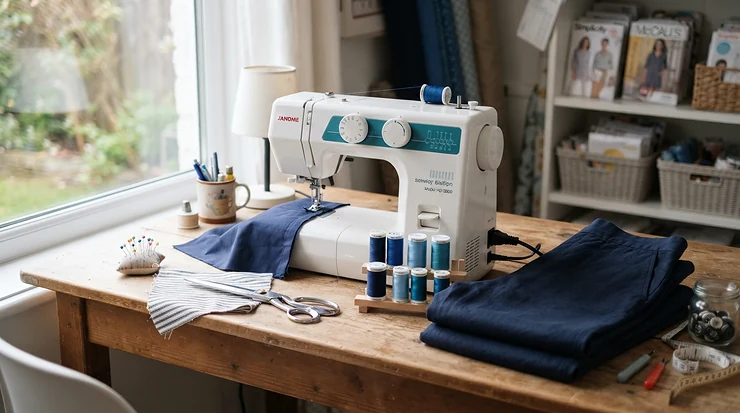
A mechanical sewing machine for denim hemming is a dial-operated, non-computerized machine built with a strong motor, a metal or aluminum frame, and enough presser foot clearance to punch through the stacked layers at a jeans hem. It trades digital extras for brute reliability and simple, hands-on control. 🧵
Here’s the problem it solves. Denim is a dense twill, and a hem puts that twill in its worst possible form. At the side seam and inseam, the fabric stacks up like a speed bump. A flimsy machine skips stitches, snaps needles, or just stalls. A purpose-built heavy-duty mechanical machine shrugs.
Mechanical models also win on simplicity. No screens to fail, no firmware, no menus. You turn a dial, you sew.
This guide covers seven real machines from budget to premium. It also explains the features that matter most: a sewing machine for hemming jeans thick seams demands the right motor, the right foot clearance, and the right accessories. The hump jumper tool, a high presser foot lift, and the correct jeans needle size each get a full section. Everything here is analysis built from published specs and aggregated review sentiment, not hands-on testing.
Quick Comparison: 7 Best Mechanical Sewing Machines for Denim Hemming
| Machine | Stitches | Key Trait | Price Range | Best For |
|---|---|---|---|---|
| Singer Heavy Duty 4411 | 11 | 1,100 SPM, metal frame | $190-$250 | Tight budgets, straight hems |
| Singer Heavy Duty 4423 | 23 | Needle threader, one-step buttonhole | $200-$300 | Best all-round value |
| Singer Heavy Duty 4452 | 110 applications | Metal needle plate | $210-$260 | Frequent hemmers |
| Brother ST371HD | 37 | 7 mm stitch width | $220-$340 | Mixed-fabric households |
| Janome HD1000 | 14 | Aluminum body, extra-high lift | $380-$420 | Durability fans |
| Janome HD3000 | 18 | Top-loading bobbin, foot pressure dial | $430-$490 | Serious hobbyists |
| Juki TL-2000Qi | Straight stitch | Straight-stitch specialist | $700-$800 | Perfectionists |
The cheapest entries share a core promise: a stronger motor and a metal frame at a modest price. The Singer Heavy Duty 4423 is where most buyers should start looking, because it adds a needle threader and one-step buttonhole without a large price jump. Spend more only if you want the sturdier aluminum construction of the Janome HD1000 and Janome HD3000, or the straight-stitch precision of the Juki TL-2000Qi.
💬 Just one click — help others make better buying decisions too!😊
Top 7 Mechanical Sewing Machines for Denim Hemming: Expert Analysis
1. Singer Heavy Duty 4411 — cheapest way into serious power
The Singer Heavy Duty 4411 is the stripped-down workhorse of the lineup. It offers 11 built-in stitches, a metal frame, and a motor Singer rates 60% stronger than standard models, with speeds up to 1,100 stitches per minute.
On paper, that frame matters most. A rigid body stops the machine flexing under load, so stitches stay even when you cross a seam. The 11 stitches sound limiting, but a hem needs only straight stitch and perhaps a zigzag. There is no needle threader, so expect a little squinting.
Based on the spec comparison, it suits people who hem a few pairs a month and want to keep spending low. Aggregated listings show reviewers rating it around 4.4 to 4.5 out of 5, with praise for its punch through layered denim at the side-seam intersection. Some reviewers note it works best when you stay within roughly six to eight layers.
Pros:
- ✅ Strong motor for the price
- ✅ Metal frame resists flexing
- ✅ Fast stitching speed
Cons:
- ❌ No automatic needle threader
- ❌ Few decorative or utility stitches
Price range: roughly $190-$250. Verdict: top value if hems are your main job.
2. Singer Heavy Duty 4423 — best balance of power and convenience
The Singer Heavy Duty 4423 is the most frequently recommended pick in the roundups reviewed. It packs 23 built-in stitches (97 applications), a one-step buttonhole, a built-in needle threader, and a top drop-in bobbin, in a metal-frame body running up to 1,100 stitches per minute.
Maximum stitch width is 6 mm, and length tops out at 4 mm. Hemming rarely needs more than 3 to 4 mm. The extra-high presser foot lift and adjustable presser foot pressure are the real hem helpers: lift gives clearance, pressure adjustment keeps feeding steady over bulk.
Here’s what the spec sheet won’t tell you. A drop-in bobbin means you can see the thread level without lifting out the case, which is handy when topstitching thread runs low mid-hem. One independent review reported the machine powering through three layers of hardy denim.
Reviewers broadly rate it around 4.5 out of 5. Common praise centers on sturdiness; common complaints involve a learning curve with its stitch-selection dials.
Pros:
- ✅ Needle threader and drop-in bobbin
- ✅ Extra-high presser foot lift
- ✅ Adjustable presser foot pressure
Cons:
- ❌ Dial system takes practice
- ❌ Only 4 mm maximum stitch length
Price range: roughly $200-$300. Verdict: the default recommendation.
3. Singer Heavy Duty 4452 — metal needle plate for smoother feeding
The Singer Heavy Duty 4452 is the Singer Heavy Duty 4423‘s sibling with a bigger stitch menu (110 stitch applications). Its standout is a metal needle plate, which helps fabric glide under the foot rather than snagging.
Why care? Denim hems are friction-heavy. The 1,100-stitches-per-minute motor means little if the fabric grabs, so a smooth plate protects stitch consistency on long, slippery runs around a leg opening. The free arm helps too, letting you slide a narrow pant cuff around the sewing area.
Honestly, hemmers rarely need 110 applications. Pick this one if you also sew home décor or costumes and want the extras. Reviewers praise how it handles multiple denim layers without bogging down and note its usefulness for custom denim clothing. A smaller group report timing problems over time and frustration with warranty support, so check seller return policies.
Pros:
- ✅ Metal needle plate for smoother feeding
- ✅ Free arm helps with narrow cuffs
- ✅ Large stitch selection
Cons:
- ❌ Some reports of timing issues
- ❌ Extras go unused for hemming
Price range: roughly $210-$260. Verdict: worth it only if you want the variety.
4. Brother ST371HD — wide stitches for mixed-fabric households
The Brother ST371HD sits in Brother’s “Strong & Tough” line. It offers 37 built-in stitches, a 7 mm maximum stitch width, and a quick-set drop-in top bobbin. Several retailers and reviewers classify it as a mechanical home machine, though it includes a small LCD readout, so confirm the control style before buying.
That 7 mm width is wider than the Singers’ 6 mm. For denim hemming it barely matters, but it shows the machine’s breadth for stretch and decorative work. At roughly 14 pounds, it is portable enough to store between hemming sessions.
Its fit is the household sewing mixed jobs: jeans on Monday, curtains on Saturday. One aggregator lists it around 4.5 out of 5 across a couple thousand ratings, with reviewers praising its balance of simplicity and range.
Pros:
- ✅ Wide 7 mm maximum stitch width
- ✅ Quick-set drop-in top bobbin
- ✅ Light enough to move around
Cons:
- ❌ LCD readout blurs the “mechanical” label
- ❌ Lighter than all-metal competitors
Price range: roughly $220-$340, with retail listings varying. Verdict: a flexible all-rounder.
5. Janome HD1000 — aluminum tank with extra-high clearance
The Janome HD1000 is the mechanical purist’s pick. It has a heavy-duty aluminum body, 14 stitches, a four-step buttonhole, a free arm, drop feed, and an extra-high presser foot lift. The front-loading vertical oscillating hook bobbin is deliberately traditional.
Aluminum construction gives rigidity and heft, around 17 pounds. That weight is not a flaw: a heavy machine stays planted when you push through a crossed seam. Janome also lists a maximum 5 mm stitch width and a 4 mm length, plenty for hems. Stitch speed is lower than the Singers at 840 per minute, but hem control often beats raw speed.
Review data is thinner here. One retailer page shows only a handful of ratings, so rely instead on its consistent reputation for durability across roundups. Buyers sometimes grumble about the four-step buttonhole.
Pros:
- ✅ Aluminum body for stability
- ✅ Extra-high presser foot lift
- ✅ Full control over tension and length
Cons:
- ❌ Four-step buttonhole is slower
- ❌ Higher price than Singer rivals
Price range: roughly $380-$420. Verdict: pay extra for build quality, not features.
6. Janome HD3000 — foot pressure dial and top-loading bobbin
The Janome HD3000 upgrades the Janome HD1000 formula. It adds 18 stitches, a one-step buttonhole, automatic reverse, a top-loading full-rotary bobbin, and foot pressure adjustment, all inside an aluminum body running around 860 stitches per minute.
Foot pressure adjustment is the hem-friendly detail. Lower pressure helps thick seams slide under the foot instead of stalling. Top-loading bobbins also let you check thread without disassembly.
This is the machine for sewists who hem constantly or tackle projects beyond hems. The extra cost buys comfort and control more than horsepower. Verified review volume on listings is thin, so treat reputation across multiple roundups as the main signal rather than star averages.
Pros:
- ✅ Foot pressure adjustment dial
- ✅ Top-loading full-rotary bobbin
- ✅ Automatic reverse stitching
Cons:
- ❌ Slower than Singer rivals
- ❌ Costs noticeably more
Price range: roughly $430-$490. Verdict: justified for heavy users.
7. Juki TL-2000Qi — straight-stitch precision
The Juki TL-2000Qi is a different animal: straight stitch only, no zigzag, no decorative menu. Roundups describe it as Juki’s best-selling home machine, with enough power for denim.
A single-purpose machine focuses everything on one stitch. Juki’s published spec lists speeds up to 1,500 stitches per minute, though verify against the current spec sheet. It typically ships with a knee lifter and thread trimmer, meaning your hands stay on the fabric when crossing seams. That workflow matters when you must lift the foot repeatedly to place a hump jumper tool.
The catch: no zigzag means no finishing raw edges or sewing stretch denim with stretch stitches. For hem-only buyers, that’s fine. Review volume on listings is small, so lean on the machine’s reputation.
Pros:
- ✅ Straight-stitch precision
- ✅ Fast, smooth sewing
- ✅ Hands-free lifting options
Cons:
- ❌ No zigzag stitching
- ❌ Highest price in this list
Price range: roughly $700-$800. Verdict: only for dedicated enthusiasts.
✨ Don’t Miss These Exclusive Deals!
🔍 Take your denim hemming to the next level with these carefully selected machines. Click on any highlighted item to check current pricing and availability. These tools will help you create authentic, professional-looking hems your whole family will love!
How to Choose a Mechanical Sewing Machine for Denim Hemming
Buying one is simpler than the marketing suggests. Weigh these seven criteria in order:
- Motor power. Look for a “heavy duty” rating and stated piercing power. Weak motors skip stitches at seams.
- Frame material. Metal or aluminum resists flexing. Plastic bodies shift when stressed.
- Presser foot clearance. A high presser foot lift lets you slide bulk under the foot.
- Foot pressure control. Adjustable pressure prevents stalling at thick seams.
- Stitch needs. A hem needs straight stitch and zigzag. Extra stitches don’t improve hems.
- Bobbin style. Top-loading simplifies thread checks; front-loading is traditional.
- Warranty and support. Reviewers often cite support experience as decisive.
Notice what’s missing from the list: stitch count. Marketing loves big numbers, but a mechanical sewing machine for denim hemming earns its keep through power and clearance, not through a decorative menu you’ll never open.
Sewing Machine for Hemming Jeans Thick Seams: What Really Matters
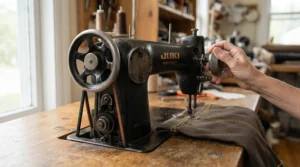
The real enemy is the seam crossing. According to the American Sewing Guild, the hem area of jeans can be up to eight layers thick depending on how the side and inseams are constructed. Your machine feels that bump in three ways.
First, the presser foot tilts as it climbs onto the thick spot, so the needle no longer hits the feed dogs’ rhythm. Stitches skip. Second, the motor loses speed under load. Third, needles flex and snap.
A sewing machine for hemming jeans thick seams should therefore combine a strong motor with a rigid frame and good foot clearance. Pair it with techniques that reduce bulk: trim seam allowances at the fold, hammer the seam flat, and slow your pace by turning the handwheel by hand.
Machines with adjustable presser foot pressure, like the Singer Heavy Duty 4423 and Janome HD3000, give extra leverage here. Lower pressure lets thick fabric slide rather than jam. Even so, remember that a domestic machine has limits, and your manual states them.
High Presser Foot Lift: Why Clearance Matters
A high presser foot lift is simply how far the foot rises above the needle plate. More lift means more room to slip a bulky seam under the foot without forcing it.
Don’t confuse clearance with strength. Lift gets the fabric in position; motor power and needle sharpness push through it. Think of it as a doorway: wide enough to enter, but you still need legs to walk.
Machines advertising extra-high clearance include the Singer Heavy Duty 4423 and Janome HD1000. Janome says its lift suits multiple layers of denim, heavy fleece, and thick quilts.
In practice, a high presser foot lift pays off when starting a hem at a crossed seam, when placing a hump jumper tool behind the foot, or when swapping between topstitching thread and standard thread. Verify the number in the manual rather than assuming; “extra-high” is a marketing phrase, not a measurement.
Hump Jumper Tool: The $5 Fix for Skipped Stitches
A hump jumper tool (also called a seam jumper or bulky seam aid) is a small, flat wedge, often plastic, that levels your presser foot as it approaches a thick seam. Some are double-ended: one popular model offers a 1/8-inch end and a 3/16-inch end for different thicknesses.
Here’s the principle. When the foot climbs a seam, its back end lifts and tilts, the feed dogs lose grip, and stitches skip. Slide the tool behind the foot and it props the back to the same height, keeping everything flat.
BERNINA’s tutorial on using the height compensation tool describes the method: lift the foot, slide the tool behind the needle, lower the foot, sew a few stitches, then move it to the front as the foot descends the other side.
No tool handy? A folded piece of cardboard works as a stopgap, as several tutorials note. A hump jumper tool costs little and works on any machine, making it the best-value upgrade for denim hemming.
Jeans Needle Size: Matching the Needle to the Denim
Jeans needle size causes more failed hems than most people expect. Needle sizes use two numbers: the European number is diameter in hundredths of a millimeter (so 100 means 1.00 mm), while the American number is the older equivalent.
| Denim Type | Jeans Needle Size | Schmetz Color Code | Best For |
|---|---|---|---|
| Lightweight, chambray | 80/12 to 90/14 | Orange / Blue | Shirts, summer pants |
| Mid-weight jeans | 100/16 | Purple | Everyday hems |
| Heavy or layered seams | 110/18 | Yellow | Workwear, thick crossings |
| Stretch denim | Stretch or ballpoint, 90/14-100/16 | Varies | Skinny jeans |
Most roundups agree that mid-weight jeans suit a 100/16, while heavier denim and topstitching thread suit 110/18. Choose a jeans needle (sharp point, stiff shank) for woven denim and a stretch needle for denim with elastane.
Looking at the table, 100/16 is the safest starting point, and stepping up to 110/18 for seam crossings is a sensible escalation. Replace needles often: a blunt one behaves like a smaller, weaker version of the wrong size.
How to Hem Jeans on a Mechanical Machine (Step by Step)
- Measure and mark the new length, leaving about an inch past the hemline for folding.
- Fold and press. Use a clapper or firm iron pressure to flatten each fold before sewing.
- Reduce bulk. Trim fabric at seam allowances where folds stack.
- Install a fresh needle in the right jeans needle size (100/16 for most jeans).
- Lengthen the stitch to roughly 3 to 4 mm for topstitching strength.
- Start at an even spot away from a seam.
- Level the foot at crossings with a hump jumper tool or cardboard, then sew slowly, using the handwheel if needed.
- Press again and trim loose threads.
Practice on offcuts first. Matching thread weight to needle size matters: heavier topstitching thread wants a larger eye. If you plan to keep original hems, the tutorial approach is similar, except you fold the extra length under rather than cutting it.
Problem → Solution: Fixing Common Denim Hemming Headaches
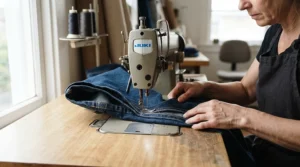
Skipped stitches at seams. The foot is tilting. Add a hump jumper tool, slow down, and switch to a fresh needle.
Broken needles. Usually caused by pushing fabric or using too small a needle. Step up to 110/18 for bulky crossings and stop forcing the cloth.
Puckered hems. Press each fold, reduce foot pressure if your machine allows (as on the Janome HD3000), and ease fabric rather than pulling it.
Thread bunching underneath. Re-thread with the foot raised so tension discs seat properly. Check bobbin winding.
Machine stalls at the seam. Turn the handwheel manually through the thick section. Machines with a high presser foot lift, such as the Singer Heavy Duty 4423, make it easier to position the fabric before restarting.
Each fix comes down to the same idea: help the machine’s feeding system stay level, supported, and unrushed.
Which Machine Fits Which Sewist? Real-World Scenarios
The weekend hemmer. Someone shortening two or three pairs a month on a tight budget suits the Singer Heavy Duty 4411. Add a hump jumper tool and the right needles for the best return.
The thrift-store flipper. Frequent alterations and mixed repairs fit the Singer Heavy Duty 4423, whose needle threader saves time across many small jobs.
The family sewist. Curtains, school costumes, and jeans share one machine in this household. The Brother ST371HD covers the range.
The durability buyer. Someone who wants one machine for a decade should look at the Janome HD1000 or Janome HD3000, with aluminum bodies and adjustable features.
The hem-only perfectionist. The Juki TL-2000Qi rewards the sewist who values clean straight stitching above all.
Match the machine to frequency, budget, and fabric mix, not to the longest feature list.
Mechanical vs Computerized Sewing Machines for Denim
| Factor | Mechanical | Computerized | Best For |
|---|---|---|---|
| Controls | Dials, levers | Buttons, screen | Mechanical: simplicity |
| Repairs | Easier, fewer parts | Electronics can fail | Mechanical: longevity |
| Stitch variety | Limited | Often hundreds | Computerized: crafters |
| Price | Often lower | Often higher | Mechanical: budgets |
The modern sewing machine has evolved from purely mechanical designs, yet the mechanical layout still suits heavy fabrics. Fewer electronic components mean fewer things that can break under demanding use.
Reading the table, the trade-off is clear: computerized machines give you creative range, while mechanical ones give you directness. For denim hemming, you rarely need range. If you also want automatic features like needle-down or built-in thread cutting, computerized models deliver, but a good mechanical machine does the core job at lower cost.
Long-Term Cost and Maintenance
| Item | Typical Range | Value Note |
|---|---|---|
| Budget heavy-duty machine | $190-$300 | Lowest cost per hem |
| Aluminum-body machine | $380-$490 | Longer lifespan potential |
| Hump jumper tool | A few dollars | Highest value upgrade |
| Needle packs | Under $10 | Replace regularly |
Total ownership cost is mostly about replacing needles, oiling where the manual says, and cleaning lint. Mechanical machines reward routine care: brush out the bobbin area after each project and swap needles after roughly every few hours of sewing.
Judged by cost per hem, even a mid-priced machine pays for itself quickly compared with tailor fees. The Singer Heavy Duty 4423 pays back soonest, while the Janome HD1000 trades a higher entry price for potentially longer service.
Common Mistakes When Buying a Mechanical Sewing Machine for Denim Hemming
Chasing stitch counts is the classic blunder. A model with 100 stitches won’t hem better than one with 11 if its motor is weaker.
Skipping needles is the next. Buyers spend hundreds on the machine, then use a universal needle on dense twill. Match the jeans needle size to the denim.
Ignoring the manual’s layer limits is a third. Domestic machines have ceilings, and pushing past them risks damage.
Finally, many forget accessories. A hump jumper tool and spare needles cost far less than a repair bill. Treat them as part of the purchase, not an afterthought.
Frequently Asked Questions
❓ What is the best thread for hemming jeans on a home machine?
❓ Can a mechanical machine sew over the original jeans hem?
❓ Do I need a walking foot for denim hemming?
❓ How often should I change the needle when hemming jeans?
❓ Is a heavier machine better for denim?
Conclusion
Hemming jeans is a small job with a big personality. The secret is respecting the seam crossing: a strong motor, a rigid frame, a high presser foot lift, the correct jeans needle size, and a humble hump jumper tool.
For most readers, the Singer Heavy Duty 4423 is the sensible starting point, balancing power, convenience, and cost. Choose the Singer Heavy Duty 4411 if every dollar counts, and the Singer Heavy Duty 4452 if you want a bigger stitch menu. The Brother ST371HD suits mixed-fabric homes, while the Janome HD1000 and Janome HD3000 reward buyers who prize aluminum durability. The Juki TL-2000Qi is the specialist’s luxury.
The right mechanical sewing machine for denim hemming turns a dreaded chore into a ten-minute fix, and every pair you save is money back in your pocket.
✨ Ready to hem like a pro? 🧵 Compare current prices on your favorite machine, grab a hump jumper tool and fresh jeans needles, and start turning too-long denim into perfectly fitted pairs today! 💪
Recommended for You
- [Add your blog post link 1]
- [Add your blog post link 2]
- [Add your blog post link 3]
Disclaimer: This article contains affiliate links. As an Amazon Associate, I earn from qualifying purchases. If you purchase products through these links, we may earn a small commission at no additional cost to you.
✨ Found this helpful? Share it with your friends! 💬🤗
