
In This Article
Threading a needle is the smallest chore in sewing, and somehow it ends more sewing sessions than any bad seam. Squint, miss, sigh, repeat. A computerized sewing machine with automatic needle threader turns that ritual into a lever push. The same microprocessor also takes over a dozen other jobs: stitch length, width, tension, buttonhole sizing, even trimming your thread tails.
The idea isn’t new. Brother’s own museum credits its OPUS-8 from 1979 as the industry’s first computerized home sewing machine, so the category has had nearly five decades to mature. What has changed is how far the technology has trickled down. LCD screens, a needle up down button and one-step buttonhole sensing once lived on four-figure machines. Now they show up in the few-hundred-dollar range.
That’s good news, and also a minefield. Spec sheets all sound alike, and a “165-stitch” machine can feel wildly different from a “600-stitch” one. So this guide does the translating. It compares seven real machines across budget, mid-range and premium tiers, using manufacturer specifications and aggregated reviewer feedback. For every feature, it explains what happens at the sewing table, not just on the box.
Along the way we’ll tackle the sewing machine with auto thread cutter question. We’ll look at what a computerized sewing machine with LCD screen really buys you, how programmable stitch memory works in practice, and why the one-step buttonhole is the quiet hero of garment sewing.
Grab a coffee. Your needle is about to thread itself.
Quick Comparison: 7 Computerized Sewing Machines with Automatic Needle Threaders
| Machine | Stitches | Auto Thread Cutter | Display | One-Step Buttonholes | Price Range | Best For |
|---|---|---|---|---|---|---|
| Brother CS7000X | 70 | Manual built-in cutter | LCD | 7 | $250–$400 | First-time computerized buyers |
| Brother XR9550 | 165 (55 alphanumeric) | Manual built-in cutter | LCD | 8 | $250–$400 | Monograms on a budget |
| Janome 3160QDC | 60 | Yes (memorized) | LCD | 6 | Mid-range, dealer-set | Repetitive seams and quick trims |
| Singer Quantum Stylist 9960 | 600 | Yes (trimmer button) | LCD | 13 | $450–$600 | Stitch-variety lovers |
| Brother SE700 | 103 + 135 embroidery designs | Check spec sheet | 3.7″ touchscreen | One-step, auto-size | $500–$650 | Sewing plus embroidery |
| Janome Memory Craft 6700P | 200 + 5 alphabets | Yes | LCD | 9 | Premium ($1,000+) | Serious dressmakers and quilters |
| Juki HZL-NX7 Kirei | 351 + 4 fonts | Yes | 7″ touchscreen | 20 patterns, sensor | $3,500–$5,500 | Pros and big-project quilters |
The table shows a clear split. Only the upper tiers (Janome 3160QDC, Singer Quantum Stylist 9960, Janome Memory Craft 6700P, Juki HZL-NX7 Kirei) offer true automatic trimming. The budget Brother CS7000X and Brother XR9550 give you more stitches per dollar but leave the snipping to you. If trimming matters most, the Janome 3160QDC is the cheapest way in. If stitch variety is the goal, the Singer Quantum Stylist 9960 leads the pack by a wide margin.
💬 Just one click — help others make better buying decisions too!😊
Top 7 Computerized Sewing Machines with Automatic Needle Threaders: Expert Analysis
Prices below are ranges only and shift often, so check current price before you buy. Specs come from manufacturer and retailer listings. Review sentiment is summarized from published reviews and retailer ratings at the time of research.
1. Brother CS7000X — best entry point into computerized sewing
If you want the gentlest on-ramp to computerized sewing, the Brother CS7000X pairs an LCD with a revised needle threader that Brother pitches as an upgrade over its older design. The 70 built-in stitches span utility, quilting, decorative and heirloom options, which is more than most home sewists rotate through in a year. The seven one-step buttonholes mean you drop the button into the foot and let the machine measure. The included wide table is the sleeper feature, because it gives quilt-sized projects somewhere to rest instead of dragging on the needle.
On paper this is a machine for people who want automation without a learning cliff. One detailed owner-style review reports that top speed is capped at 750 stitches per minute, so it’s relaxed rather than racy. Reviewers generally describe the new threader as a step up from earlier Brother models, though one longtime Brother sewist still prefers the simpler threaders on other models in the lineup. Retail listings at the time of research showed ratings around 4.5 stars.
Pros:
- ✅ Improved needle threader versus older Brother designs
- ✅ Wide extension table included
- ✅ Simple LCD stitch selection
Cons:
- ❌ Speed reportedly capped near 750 stitches per minute
- ❌ No automatic thread trimming
Around the $250–$400 range depending on retailer. It’s strong value as a first computerized machine.
2. Brother XR9550 — the most stitches per dollar
The Brother XR9550 is the stitch-library bargain. It packs 165 built-in stitches, 55 of them alphanumeric, plus eight one-step auto-size buttonhole styles, an LCD, a brightly lit LED work area and a wide table. Those 55 letters and numbers mean you can label a quilt, monogram a tote or personalize a baby blanket without buying a separate embroidery machine. The LED lighting matters more than it sounds, because dark seams are where crooked stitching begins.
Based on the spec comparison, this machine suits someone who wants decorative range without a premium price tag. One caution is naming. Brother’s own page lists the Project Runway XR9550PRW variant as discontinued, while the XR9550 remains widely sold, so confirm the exact model at checkout. Reviewers on retailer pages are warm, including a longtime Brother owner who spent decades on an older machine before upgrading. One review site rates it around 4.6 stars.
Pros:
- ✅ 165 stitches including built-in lettering
- ✅ Eight one-step buttonhole styles
- ✅ Bright LED work area
Cons:
- ❌ Thread cutting is manual
- ❌ Variant naming can confuse shoppers
Typically in the $250–$400 range. This is excellent value for creative hobbyists.
3. Janome 3160QDC — the trimmer-and-needle-position workhorse
Where the budget Brothers stop at manual cutters, the Janome 3160QDC adds a memorized automatic thread cutter, which makes it a sewing machine with auto thread cutter at a mid-range price. It also offers 60 stitches including six automatic buttonholes, a memorized needle up down button, a one-hand needle threader, a lock stitch button and a speed slider. The Superior Plus feed system and 7-piece feed dog keep fabric moving evenly, and the horizontal rotary hook supports a 7mm zigzag.
What the spec sheet won’t tell you is how much the trimmer and lock stitch combination speeds up repetitive sewing. One published review of the 3160QDC-G variant called those two features the biggest time savers when finishing many seams in a row. That same review noted the machine is light enough to carry to classes. If you sew in batches, such as pillowcases, tote bags or quilt blocks, this is the logical pick.
Pros:
- ✅ Memorized automatic thread cutter
- ✅ Memorized needle up down button
- ✅ Dependable feed system for layered fabric
Cons:
- ❌ Smaller stitch library than rivals
- ❌ Thread tension is manual
Pricing is dealer-set and sits in the mid-range tier. Confirm current price with an authorized seller.
4. Singer Quantum Stylist 9960 — 600 stitches and 13 buttonholes
The Singer Quantum Stylist 9960 is the maximalist of the group. It offers 600 built-in stitches including five alphanumeric fonts, 13 fully automatic one-step buttonholes, an automatic needle threader, a thread trimmer button, a memorized needle up down function, automatic stitch length and width, and a removable extension table. Sewists who like to experiment will appreciate that the machine suggests settings for each stitch.
Aggregated sentiment is positive but nuanced. Retailer ratings hover around 4.5 stars across well over a thousand reviews. A Best Buy Q&A response says it isn’t generally considered a beginner machine simply because it has so many features. One owner-style review blames most complaints on incorrect tension settings. One review aggregator notes some users reported durability issues, so register your warranty and keep your receipt.
Pros:
- ✅ Massive stitch and font library
- ✅ 13 one-step buttonhole styles
- ✅ Extension table included
Cons:
- ❌ Feature overload for absolute beginners
- ❌ Mixed durability reports from some users
Roughly the $450–$600 range. This is a feature-per-dollar standout if you’ll actually use the options.
5. Brother SE700 — sewing and embroidery in one body
The Brother SE700 is the lesser-known alternative that earns a spot because it’s really two machines. It offers 103 built-in sewing stitches, 135 built-in embroidery designs, a 3.7-inch color LCD touchscreen with design preview, a 4″ x 4″ embroidery area, Wireless LAN connectivity and eight included feet. Brother lists automatic needle threading, and since the touchscreen sits front and center, it’s also the clearest computerized sewing machine with LCD screen experience in this roundup.
The reasoning is simple. If you’d otherwise buy a separate embroidery unit later, this machine bundles that capability now. The 4″ x 4″ hoop limits design size, so it’s perfect for pockets, patches and monograms but not jacket backs. Verify the thread cutter and buttonhole style count on the current spec sheet, since listings vary by bundle. Retailer ratings at the time of research ranged from about 4.5 to 4.7 stars.
Pros:
- ✅ Sewing and embroidery in one machine
- ✅ Color touchscreen with design preview
- ✅ Wireless design transfer
Cons:
- ❌ Small 4″ x 4″ embroidery area
- ❌ Bundle contents vary by retailer
Typically in the $500–$650 range. Value is strong if embroidery is on your wish list.
6. Janome Memory Craft 6700P — fastest top-loader for serious projects
The Janome Memory Craft 6700P is built for people who sew long and fast. It reaches 1,200 stitches per minute, which dealers describe as among the quickest top-loading bobbin machines. It pairs that speed with a 10-inch all-metal flatbed and AcuFeed Flex dual feed, so layered quilts and slippery fabrics move through together instead of creeping. You also get 200 stitches plus five alphabets, nine one-step buttonholes, a superior needle threader, an automatic cutter that trims both top and bobbin thread, and memorized needle position.
One European retailer listing also describes the ability to program a sequence of stitches, the closest thing in this lineup to genuine programmable stitch memory. At roughly 24 pounds, it’s a studio machine rather than a classroom carry. A published UK review calls it an excellent choice for serious dressmakers and quilters while acknowledging it’s a major investment.
Pros:
- ✅ 1,200 stitches per minute with dual feed
- ✅ Automatic trimming of both threads
- ✅ Spacious 10-inch metal flatbed
Cons:
- ❌ Manual thread tension control
- ❌ Premium price demands heavy use to justify
A four-figure premium tier, well above $1,000. It makes sense only for high-volume sewists.
7. Juki HZL-NX7 Kirei — professional-grade box feed and a 7-inch touchscreen
The Juki HZL-NX7 Kirei is the dream-machine entry. It has a 7-inch LCD touchscreen (800 x 480), 351 stitches with four fonts, and 20 buttonhole patterns with automatic sensor sizing. It also offers digital tension, a box feed mechanism, a JUKI Smart Feed dual feed system, and a one-hand needle threader. Automatic lock stitch, thread trimming and presser foot lifting round out the automation. A bobbin thread counter, six LEDs and a knee lifter are bonuses.
What most buyers overlook is the interchangeable single-needle system and straight stitch plate, which are the difference between “good” and “crisp” piecing. Juki’s brochure traces its home machines back to 1947, so the heritage is real. I couldn’t verify enough independent buyer reviews to summarize them responsibly, so treat the praise as spec-driven rather than sentiment-driven.
Pros:
- ✅ Digital tension plus dual feed control
- ✅ Sensor-sized buttonholes, 20 styles
- ✅ Large touchscreen with detailed visuals
Cons:
- ❌ Very high price
- ❌ Limited independent review data
Listed in the roughly $3,500–$5,500 range depending on retailer promotions. This is a pro-level purchase.
✨ Don’t Miss These Exclusive Deals!
🔍 Take your sewing to the next level with these carefully selected machines. Click on any highlighted product name to check current pricing and availability. The right computerized machine will help you create polished, professional-looking projects your family will love!
Setup and First-30-Days Guide for Your New Computerized Machine
Amazon listings tell you what a machine has. They rarely tell you how to live with it. Here’s a practical first-month roadmap.
Week one: get the basics right. Install a fresh needle, flat side facing the way your manual specifies. Thread with the presser foot up and the needle at its highest position. One service technician notes that threader hooks get bent when the needle isn’t fully raised or when the needle bar moves while the hook is in the eye, so a lever push at the wrong moment is the most common way to wreck the mechanism.
Week two: test on scrap. Cut swatches of your actual fabrics and run through straight, zigzag and buttonhole stitches. Let the machine’s automatic tension do its job before you touch any dial, since changing too many variables at once is how a good machine gets blamed for a bad setup.
Weeks three and four: build habits. Clean lint from the bobbin area after every few projects. Change the needle after a heavy project or any time stitches start skipping. Use the needle up down button for pivots, and for machines that offer it, set the needle to stop down.
Common 30-day mistakes:
- Forgetting to raise the presser foot when threading
- Using the wrong needle type for knits or denim
- Ignoring the manual’s maintenance schedule
Real-World Scenarios: Which Machine Fits Which Sewist
Spec comparisons are abstract, so here are four realistic profiles.
The college student (budget around $300, dorm table, weekly mending and costume projects). The Brother CS7000X gives an LCD, a friendly threader and a wide table. Its manual cutter is a fair trade at this price.
The monogram-loving parent (budget around $400, kitchen table, weekend projects). The Brother XR9550 supplies 55 built-in letters and numbers, so labeling kids’ gear doesn’t require extra hardware. Upgrade to the Singer Quantum Stylist 9960 if you want 13 buttonhole styles and five fonts.
The Etsy tote-bag maker (hundreds of identical seams per week). The Janome 3160QDC earns its keep through the memorized automatic thread cutter and lock stitch. Every seam finishes without scissors, which adds up over a hundred bags.
The weekend quilter (long sessions, big quilts, premium budget). The Janome Memory Craft 6700P brings speed and dual feed, while the Juki HZL-NX7 Kirei adds a long throat and digital tension. If you also dream of embroidery, the Brother SE700 covers small designs at a mid-range price.
What Is a Computerized Sewing Machine with Automatic Needle Threader?
A computerized sewing machine with automatic needle threader is a microprocessor-controlled machine that selects, sizes and adjusts stitches electronically, and guides thread through the needle’s eye with a lever or button. It typically adds an LCD or touchscreen, memorized needle positions and one-step buttonholes.
For deeper background, Wikipedia’s sewing machine entry covers how stitch formation works. What separates this category from older designs is control. Mechanical machines rely on dials and cams, so every adjustment is a physical turn. Computerized models use electronics to execute precise stitch parameters repeatedly. Threader types vary too. Semi-automatic versions need you to position the thread, while fully automatic systems do most of the work after a lever press. Both help, but fully automatic ones remove more eye strain.
How to Choose a Computerized Sewing Machine with Automatic Needle Threader
Use these steps to narrow the field without guesswork.
- Define your main projects. Mending and tote bags need less than quilting or garment work. Match stitch libraries and throat space to real use.
- Decide on trimming. If you finish many seams, an automatic cutter saves minutes per project. If you sew occasionally, manual snipping is fine.
- Check the display. A readable LCD reduces menu hunting. Touchscreens are easier still but cost more.
- Count buttonhole styles. Garment sewists benefit from more one-step options.
- Inspect the feed system. Dual feed or box feed helps with slippery or layered fabrics.
- Weigh portability. Metal-frame machines are steadier but heavier. If you carry yours to classes, check the weight.
- Plan for service. A machine from a brand with local dealers is easier to keep running than one without.
Sewing Machine with Auto Thread Cutter: Is the Trimmer Worth It?
A sewing machine with auto thread cutter snips both top and bobbin threads with one button press, often pulling the top thread to the underside so the stitch doesn’t unravel. The Janome Memory Craft 6700P, Janome 3160QDC, Singer Quantum Stylist 9960 and Juki HZL-NX7 Kirei all include this feature, according to their listings.
The real value is workflow. Without a trimmer you stop, lift the foot, pull fabric, find scissors and snip, which is only seconds per seam but hundreds of times per project. One reviewer of the Janome 3160QDC described the trimmer plus lock stitch as the two biggest time savers when finishing many seams. If you sew in batches, it pays off quickly. If you sew a few projects a month, a Brother CS7000X and a pair of thread snips will do fine.
Computerized Sewing Machine with LCD Screen: What the Display Does for You
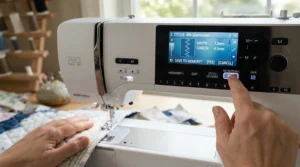
A computerized sewing machine with LCD screen turns hidden settings into visible ones. Instead of guessing which dial position gives a 3mm stitch length, you read it. Basic LCDs on machines like the Brother CS7000X and Brother XR9550 show stitch numbers, length and width. A full touchscreen like the 3.7-inch display on the Brother SE700 or the 7-inch panel on the Juki HZL-NX7 Kirei adds previews, menu navigation and even design editing.
Think of the screen as a translator between your intent and the motor. It also reduces mistakes: if you select a buttonhole mode, the display confirms it before the needle moves. Bigger screens cost more, but if you often switch stitch types they pay back in speed and fewer ripped seams.
Programmable Stitch Memory: Saving Your Favorite Combinations
Programmable stitch memory lets you string stitches together and replay them: a border pattern, an alphabet combo, a signature seam finish. Among the machines reviewed here, only the Janome Memory Craft 6700P has a retailer listing that describes programming a sequence of consecutive stitches. Janome’s discontinued Skyline S7 also advertised a Stitch Composer program, which shows how premium machines treat memory.
If programmable stitch memory matters to you, confirm exactly what each model stores. Some save sequences, others save letters, and some only remember the last-used settings. The Singer Quantum Stylist 9960, Brother XR9550 and Brother SE700 all offer lettering features, but check the current manual for memory capacity before assuming any model records custom sequences. Memory is a convenience for repeat projects, not a requirement for good sewing.
Needle Up Down Button: Small Button, Big Control
A needle up down button does exactly what the name says: it moves the needle to its highest or lowest position at a tap. Many machines “memorize” the setting so the needle stops where you choose when you stop sewing. The Janome 3160QDC and Janome Memory Craft 6700P specifically list a memorized needle position, and the Singer Quantum Stylist 9960 lists needle up down memory.
Why does it matter? Pivoting at corners requires the needle down in the fabric. Stopping with the needle up lets you reposition layers. Quilters use the button constantly to hold a block steady while turning curves. It also saves your handwheel arm, since you aren’t rolling the wheel manually for every turn. It’s a tiny feature with an outsized effect on accuracy.
One-Step Buttonhole: Let the Machine Do the Measuring
A one-step buttonhole sews all four sides of the buttonhole in a single operation, often sizing itself to your button. On the Janome 3160QDC you place the button in the automatic foot and the machine stitches a hole to the right size. On the Singer Quantum Stylist 9960, you get 13 one-step styles, while the Juki HZL-NX7 Kirei offers 20 patterns with sensor sizing.
Practical advice: always test on a scrap of your actual fabric with its interfacing. Stretch fabrics need stabilizer, and heavy fabrics may need a slower speed. A good one-step buttonhole makes shirt-making and jacket-sewing feel less intimidating, because the step beginners dread becomes repeatable.
Computerized vs Mechanical Sewing Machines: A Written Comparison
| Factor | Mechanical | Computerized | Best For |
|---|---|---|---|
| Stitch selection | Dial, limited | Buttons or touchscreen, large libraries | Computerized for variety |
| Automation | Minimal | Needle threader, cutter, buttonholes | Computerized for efficiency |
| Price | Lower | Higher | Mechanical for tight budgets |
| Repair complexity | Simpler | Electronics add complexity | Mechanical for DIY repair |
| Learning curve | Short | Moderate | Mechanical for absolute basics |
Mechanical machines still win on simplicity and repair cost, and the EBSCO research overview notes how long the basic design stayed stable before electronic and computerized models arrived. Computerized models win everywhere else: precision, speed and convenience. If you value built-in automation, such as the Janome 3160QDC‘s trimmer or the Brother XR9550‘s lettering, the computerized route is a better long-term fit. If you only sew occasionally, a basic mechanical machine may suit you.
Long-Term Cost and Maintenance: What Ownership Really Looks Like
Buying price is only the start. Computerized machines need needles, oil or lubrication per the manual, lint cleaning and occasional servicing. One industry overview notes computerized home machines can start around $400 and top-tier models run as high as $5,000, while this roundup shows entry-level models can undercut that floor. See Fibre2Fashion’s overview for the broader range.
| Tier | Machines | Typical Range | Best For |
|---|---|---|---|
| Budget | Brother CS7000X, Brother XR9550 | $250–$400 | Beginners and hobbyists |
| Mid-range | Janome 3160QDC, Singer Quantum Stylist 9960, Brother SE700 | $450–$650 | Frequent sewists and embroidery |
| Premium | Janome Memory Craft 6700P, Juki HZL-NX7 Kirei | $1,000+ | Professionals and heavy users |
Consider cost per use. A machine in the $500 range used four hours a week for five years works out to roughly 1,000 hours, which is about fifty cents per hour. Premium machines amortize well only if you sew heavily. Bottom line: match the tier to your hours, not your aspirations, and budget a bit for servicing and replacement needles.
Frequently Asked Questions
❓ Why won't my automatic needle threader work?
❓ Can a computerized sewing machine handle denim?
❓ How long does a computerized sewing machine last?
❓ Can I add new stitches or designs to my machine?
❓ Is a computerized machine too complicated for beginners?
Conclusion
The best computerized sewing machine with automatic needle threader is the one that matches your actual projects. For a gentle start, the Brother CS7000X delivers an LCD, a revised threader and a wide table in a friendly package. For lettering and decorative variety on a budget, the Brother XR9550 is hard to beat. If you sew in batches, the Janome 3160QDC brings real thread trimming at a mid-range price, and the Singer Quantum Stylist 9960 gives stitch-obsessed sewists a huge library. The Brother SE700 covers embroidery curiosity, while the Janome Memory Craft 6700P and Juki HZL-NX7 Kirei serve serious, high-volume sewing.
Whichever tier you choose, remember that features only matter when you use them. A needle up down button, a one-step buttonhole and an LCD you can read at a glance will earn their keep every single week. Pair that with good needles and a simple cleaning habit, and your machine will reward you for years.
Recommended for You
- Computerized Sewing Machine for Quilting: 7 Best Picks (2026)
- Metal Frame Mechanical Sewing Machine for Beginners: 7 Best 2026
- Mechanical Sewing Machine for Denim Hemming: 7 Best Picks 2026
Disclaimer: This article contains affiliate links. As an Amazon Associate, I earn from qualifying purchases. If you purchase products through these links, we may earn a small commission at no additional cost to you.
✨ Found this helpful? Share it with your friends! 💬🤗
